Prop Firm Stats: What the Data Tells You About Pass Rates, Payouts, and Where Traders Actually Succeed
Most traders enter prop firm challenges without looking at the numbers first. They see a profit target, a funded account size, and a marketing page that makes the process sound simple.

Most traders enter prop firm challenges without looking at the numbers first. They see a profit target, a funded account size, and a marketing page that makes the process sound simple. Then they fail. The data explains why. It also explains what separates firms that publish real performance data from those that keep their numbers hidden.
Prop firm stats matter because they reveal how a firm actually operates. Pass rates, payout averages, drawdown breach frequency, and cohort performance all tell a story that no sales page will. This article breaks down the most important prop firm statistics in the industry, explains what traders should look for when evaluating a firm, and shows how PropFunding approaches transparency differently.
The Industry-Wide Numbers Most Traders Do Not Know
The prop trading industry has grown by over 600% in global search interest since 2020. There are now more than 2,000 prop firms operating worldwide, with the majority headquartered in the United States. The industry is estimated to be worth around $20 billion as of 2026. That growth has attracted hundreds of thousands of new traders, but the success rates have not kept pace with the enthusiasm.
Across the industry, only about 5% to 10% of traders pass prop firm evaluations. Of those who do pass and receive funded accounts, roughly 7% ever receive a payout. The average trader spends over $4,000 on challenge fees before reaching profitability, if they ever do. These numbers come from multiple independent sources, including data from technology providers that power the backend of many well-known firms.
The gap between what traders expect and what the data shows is enormous. Most traders attempt three or more challenges before passing, and many never recover their total investment in fees. For a $50,000 funded account, the average profit earned by successful traders is around 4% of the allocated capital. That means a funded trader on a $50K account takes home roughly $2,000 in profit, often after spending more than that on evaluation fees alone.
Why Most Prop Firms Do Not Publish Their Stats
There is a reason most prop firms do not make their performance data public. When the numbers show that the vast majority of traders fail and only a small fraction receive payouts, it becomes harder to sell the dream of easy funded trading. Firms that rely on challenge fee revenue have a financial incentive to keep traders cycling through evaluations rather than publishing data that might discourage signups.
This lack of transparency is one of the biggest problems in the industry. Without access to real stats, traders cannot make informed decisions about which firm to trust, which account size to choose, or whether the challenge rules are realistic for their trading style.
Firms that do publish stats tend to share selective numbers. A firm might highlight its total payout volume without mentioning how many traders contributed to that number or how many failed along the way. Others publish pass rates for a single phase without showing the full funnel from signup to funded account to actual payout. Partial data creates a misleading picture that benefits the firm, not the trader.
What Prop Firm Stats Should Actually Include
A complete and honest stats page should show several key metrics. First, the evaluation pass rate is broken down by phase. A firm with a two-step evaluation should show both Phase 1 and Phase 2 pass rates separately, because the drop-off between phases is where most traders lose. Second, the percentage of funded traders who receive at least one payout. Passing an evaluation and actually withdrawing money are two different milestones, and the gap between them is usually significant.
Third, average payout size and frequency. A firm can claim millions in total payouts while its average funded trader earns a small amount per cycle. The median matters more than the total. Fourth, cohort-level performance data. If a firm funds traders in monthly cohorts, showing how each cohort performed over time gives prospective traders a realistic benchmark.
Finally, drawdown breach statistics. Knowing how many traders fail due to daily loss limits versus maximum drawdown versus profit target shortfalls helps traders understand where the real risk points are in the evaluation process.
How PropFunding Publishes Its Stats
We took a different approach to data transparency from the beginning. PropFunding publishes real-time performance data at propfunding.com/stats. This page shows aggregate pass rates, average equity curves, payout data, and cohort performance. It is publicly accessible and does not require a login or account creation.
Our Phase 1 pass rate sits around 39% to 41%, and our Phase 2 pass rate is approximately 25% to 27%. The average monthly payout for funded traders is around $4,200 to $4,800, with the highest single payout reaching $29,500. We currently have over 30,000 active funded traders on the platform.
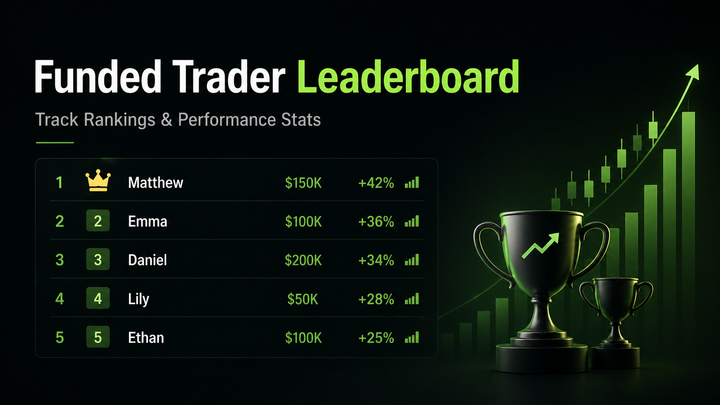
These numbers are not cherry-picked highlights. They represent the full picture of trader performance across all cohorts and account sizes. We publish them because we believe traders deserve to see the real data before committing their time and effort to any platform. Traders can also view individual rankings and track records on our leaderboard.
Why PropFunding's Stats Look Different from the Industry Average
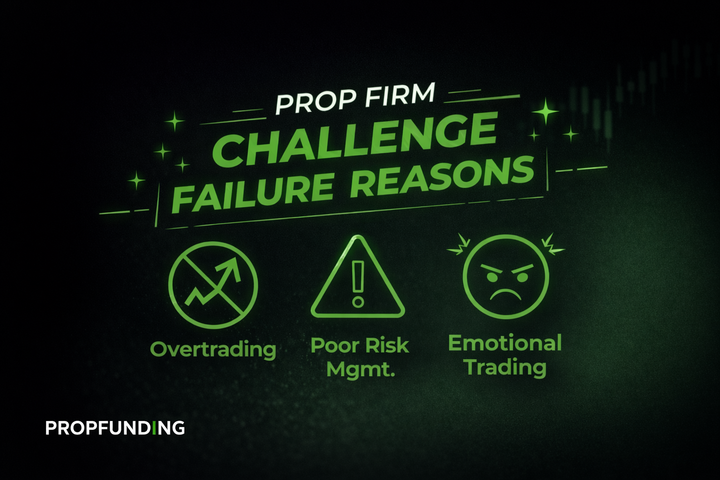
The industry-wide pass rate of 5% to 10% reflects a market dominated by firms that charge upfront fees. When traders pay hundreds or thousands of dollars before they even begin trading, the pressure to recover that cost changes their behavior. Traders overtrade, increase position sizes, and break risk rules because they feel like they need to justify the money they already spent.
PropFunding operates on a pass first, then pay model. Traders enter the challenge for free and only pay a $125 activation fee after they pass. This removes the sunk cost pressure that causes most evaluation failures. When traders are not trying to recover an upfront fee, they trade more conservatively, follow risk rules more consistently, and make better decisions under pressure. This is the core difference between PropFunding and firms that charge upfront fees.
That structural difference is why our pass rates are significantly higher than the industry average. The model does not make the challenge easier. The profit targets, drawdown limits, and minimum trading day requirements are all clearly defined and enforced. What changes is the psychological environment in which traders operate.
The Relationship Between Stats and Revenue Models
The most revealing prop firm stat is not the pass rate or the payout average. It is the revenue model. Most prop firms generate the majority of their revenue from failed challenge fees. When a firm charges $500 for an evaluation and 90% of traders fail, the math works in the firm's favor regardless of whether anyone ever gets funded.
This creates a structural conflict. The firm profits most when traders fail. That means the firm has no financial incentive to help traders pass, improve their stats, or build long-term trading careers. The leaderboard becomes decoration, and the stats page, if it exists at all, becomes a marketing tool rather than a transparency measure.
PropFunding's revenue model is built differently. Because we do not charge upfront fees, we do not profit from failed evaluations. Our revenue comes from trading data monetization. Every trade made during the challenge, whether the trader passes or fails, generates anonymized data that feeds our algorithmic and LP account strategies. This means the firm benefits when more traders participate and trade actively, regardless of their outcome. The full structure behind this model is explained in our documentation.
This alignment is reflected in our stats. We have no reason to inflate pass rates or hide payout data. The numbers are what they are, and they serve traders who want to evaluate the platform based on evidence rather than promises.
What Pass Rates Actually Tell You About a Firm
A very low pass rate does not necessarily mean a firm is unfair. Some firms set aggressive profit targets or tight drawdown limits that are genuinely difficult to hit. Others have legitimate evaluation structures that filter for highly disciplined traders. But when a firm's pass rate is extremely low, and it also charges high upfront fees, the combination suggests that the business model depends on failure volume rather than trader success.
Conversely, a very high pass rate should also raise questions. If a firm claims that 80% of traders pass its evaluation, either the challenge is too easy, the data is fabricated, or the firm is not filtering for quality. A pass rate that is too high often means the funded account stage has stricter rules that eliminate traders after they have already paid.
The most informative stat is the full funnel conversion rate. How many traders sign up, how many pass Phase 1, how many pass Phase 2, how many receive funded accounts, and how many receive at least one payout? That end-to-end number is the only stat that truly measures a firm's value to traders. At PropFunding, only the top 10% of traders in a given cohort are funded, which keeps the quality bar high while maintaining a process that rewards real skill. Traders who want to understand how the evaluation works step by step can review our complete challenge rules guide.
Payout Stats and What They Mean in Practice
Total payout volume is the most commonly promoted stat in the prop firm industry. Firms advertise figures in the tens or hundreds of millions of dollars. But that number alone means very little without context. A firm that has paid out $100 million over five years across 500,000 traders has an average payout of $200 per trader. That is not an impressive number.
What matters more is the average payout per funded trader per cycle, the median payout time, and the profit split structure. A firm offering an 80/20 split with consistent payouts every 14 days creates more predictable income than a firm offering 90/10 with unpredictable payout delays or hidden conditions.
At PropFunding, funded traders keep up to 80% of their profits. Payouts are processed every 14 days after a 30-day initial hold period. These terms are the same for every trader regardless of account size. All payout conditions, scaling rules, and funded account requirements are covered in our funded account rules.
Drawdown Stats Reveal the Real Failure Points
Industry data consistently shows that the majority of evaluation failures come from drawdown breaches, not from failing to hit profit targets. Traders who overtrade, increase position sizes after losses, or ignore daily loss limits are the ones who fail most often. The profit target is rarely the problem. The problem is risk management.
Understanding how static and trailing drawdown rules work before entering a challenge is critical. PropFunding uses clear daily loss limits and maximum loss thresholds that are documented in our challenge rules. Traders who study these rules and trade within them have a significantly better chance of passing than those who focus only on the profit target.
This is where stats become actionable. If a firm publishes data showing that 70% of failures come from daily loss limit breaches, a smart trader knows to focus on position sizing and daily risk management rather than trying to hit the profit target as fast as possible.
How to Use Prop Firm Stats When Choosing a Firm
Before committing to any prop firm, traders should ask for the following data points. If the firm does not publish them, that itself is a data point. Look for Phase 1 and Phase 2 pass rates, ideally broken down by account size. Look for the percentage of funded traders who receive payouts. Look for average and median payout amounts. Look for the firm's revenue model and whether it depends on failed challenge fees.
Compare those numbers across firms. A firm with a 25% Phase 2 pass rate and a free entry model is structurally different from a firm with a 5% pass rate and a $500 upfront fee. The stats tell you which model is designed to find good traders and which model is designed to collect fees.
PropFunding's stats are public at propfunding.com/stats. Our leaderboard is public. Our challenge rules are documented in full. We encourage traders to compare our data against any other firm in the industry before making a decision.
The Future of Prop Firm Transparency
The prop trading industry is maturing. Traders are becoming more data-literate and more skeptical of firms that hide their numbers. Regulatory pressure is increasing, and the firms that survived the 2024 consolidation are the ones that invested in infrastructure, transparency, and sustainable business models.
Stats pages will become a baseline expectation, not a differentiator. Firms that refuse to publish real performance data will lose credibility as traders learn to demand evidence before spending money. The firms that thrive will be the ones that treat transparency as a core feature, not an afterthought.
We built PropFunding around this principle. The stats page, the leaderboard, the public documentation, and the pass first, then pay model all exist because we believe traders should be able to evaluate a firm on data, not marketing. If the numbers are good, you do not need to hide them.
Start a free challenge and see the stats for yourself.