Prop Firm Challenge Failure Reasons
Many traders enter a challenge expecting quick results. However, most failures happen because of poor risk control, emotional decisions, and a lack of discipline.
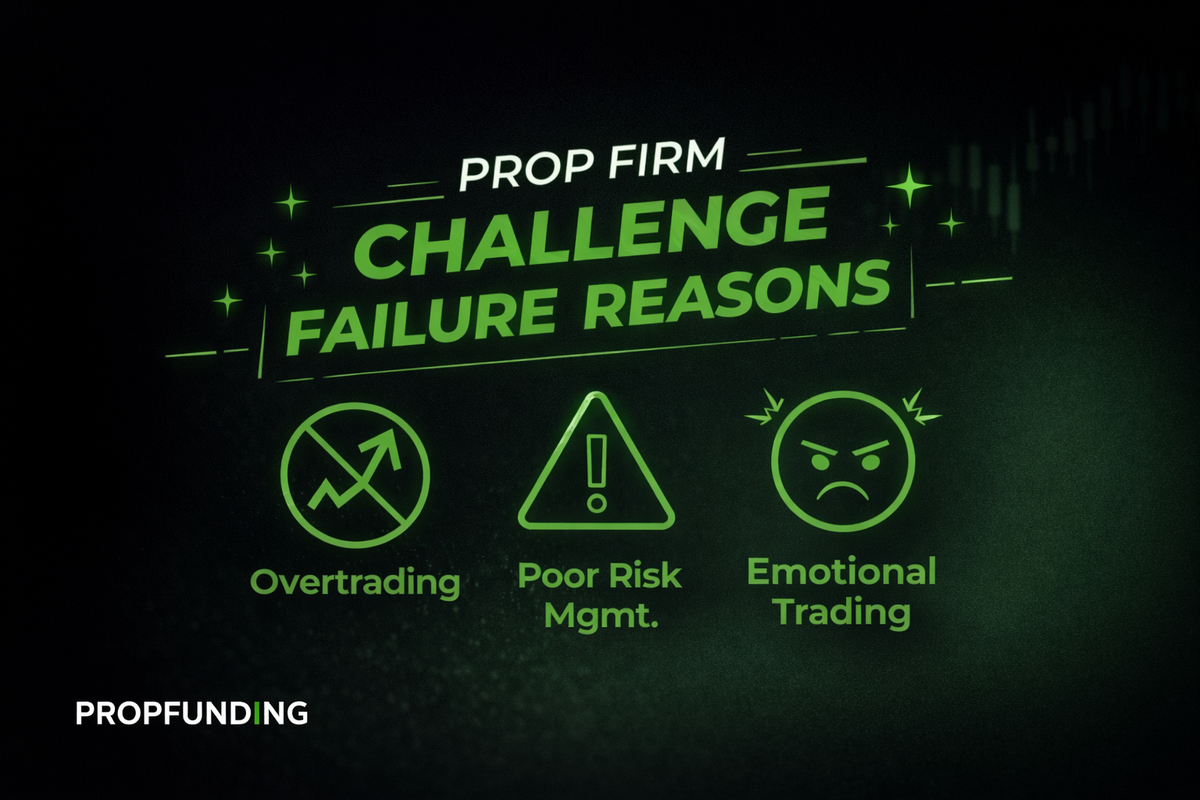
Prop firm challenge failure reasons often come down to behaviour under pressure rather than strategy alone. Many traders enter a challenge expecting quick results. However, most failures happen because of poor risk control, emotional decisions, and a lack of discipline.
A prop firm challenge is designed to test more than market knowledge. It tests patience, consistency, and control. As a result, traders who ignore these factors often fail, even if they understand the market.
Why traders fail prop firm challenges
Most traders do not fail because they cannot trade. Instead, they fail because their behavior changes under pressure. Profit targets and drawdown limits create stress. Therefore, traders start forcing trades or taking risks they would normally avoid.
In many cases, the problem is not the strategy. It is how the trader reacts to the situation.
Poor risk management
Poor risk management is one of the main reasons for prop firm failures. Even a good setup cannot save an account if the risk is too high. One large loss can quickly push the account close to its limit.
As a result, traders who increase risk after losses often fail faster. In contrast, traders who keep risk stable have a better chance of staying in the challenge longer.
Risking too much on one trade
Some traders increase position size to reach the target faster. However, if the trade fails, the damage is significant. This creates pressure and often leads to more mistakes.
Ignoring daily drawdown limits
Many traders break rules by taking extra trades after hitting a daily loss. They believe one more trade will fix the situation. Instead, this often leads to a full account breach.
Overtrading
Overtrading is another major reason for the failure of a prop firm. Many traders believe that more trades increase the chances of success. However, this usually leads to lower-quality decisions.
Because of impatience, traders take setups that do not fully meet their plan. As a result, accuracy drops and losses increase.
Revenge trading
Revenge trading is one of the most damaging reasons for the failure of a prop firm challenge. After a loss, traders try to recover quickly. Therefore, they enter trades without proper confirmation.
This emotional reaction often turns one loss into multiple losses. Over time, this pattern destroys accounts.
Lack of discipline
Discipline keeps a trader aligned with their plan. Without it, even a strong strategy fails. Many traders break rules when they feel pressure or frustration.
Breaking the trading plan
Some traders stop following their plan after a few losses. As a result, they start making random decisions instead of structured ones.
Changing strategy too fast
Other traders switch strategies too often. After a few losing trades, they assume the system does not work. Therefore, they move to something new without proper testing.
Pressure to pass too quickly
Many traders feel they must pass the challenge fast. Because of this, they take more risk than planned. They also force trades to reach the target sooner.
However, this approach usually leads to failure. A slower and more controlled approach works better over time.
Weak psychology under pressure
The mental side plays a major role in why traders fail prop firm challenges. Fear can cause hesitation. Greed can lead to overtrading. Frustration can result in rule-breaking.
As a result, even skilled traders can fail if they lose emotional control.
Not adapting to the prop firm rules
Some traders do not adjust their approach to fit prop firm rules. Instead, they trade as if they are using a personal account.
However, prop firms have strict limits. Therefore, traders must adapt their risk and execution. Those who fail to adjust often lose their accounts quickly.
How to avoid common failures
First, keep risk consistent and controlled. Small losses are easier to recover from. Second, focus on quality trades instead of quantity. Fewer strong setups lead to better results.
In addition, review your trades regularly. This helps identify mistakes early. Most importantly, stay patient. Challenges reward discipline, not speed.
Long-term growth starts with control
Passing a challenge is only the first step. Long-term success depends on consistency. When a business grows, it also means increasing revenue and income. In prop trading, this comes from controlled risk and steady performance.
Traders who focus on discipline are more likely to stay funded and grow over time.
Final thoughts
Prop firm challenge failure reasons are often simple but repeated. Poor risk management, overtrading, revenge trading, and lack of discipline cause most failures.
Traders who want to pass must focus on control, patience, and consistency. In the end, success depends less on strategy and more on behavior under pressure.