Pay Later Prop Firm Explained
Discover how pay-later prop firms work, why traders prefer them over upfront fee models, and how evaluations, risk rules, and funded payouts operate step-by-step.
A pay-later prop firm is a proprietary trading firm that allows traders to complete an evaluation before paying any fee. Instead of paying up front, the trader trades under defined rules, proves consistency, and only pays after passing the evaluation. This model changes how early risk and pressure affect trading decisions during the evaluation stage.
This page explains what a pay-later prop firm is, how the model works step by step, how it differs from upfront fee prop firms, and why traders are increasingly searching for this approach when choosing a prop firm.
What Is a Pay-Later Prop Firm
A pay-later prop firm allows traders to attempt a prop firm evaluation without paying an upfront fee. During the evaluation, traders must respect drawdown limits, daily loss limits, and profit targets. If the trader passes, payment is required to activate the funded account. If the trader fails, there is no evaluation fee lost.
The defining feature of a pay-later prop firm is timing. Proof of trading discipline comes first. Financial commitment comes only after that proof exists.
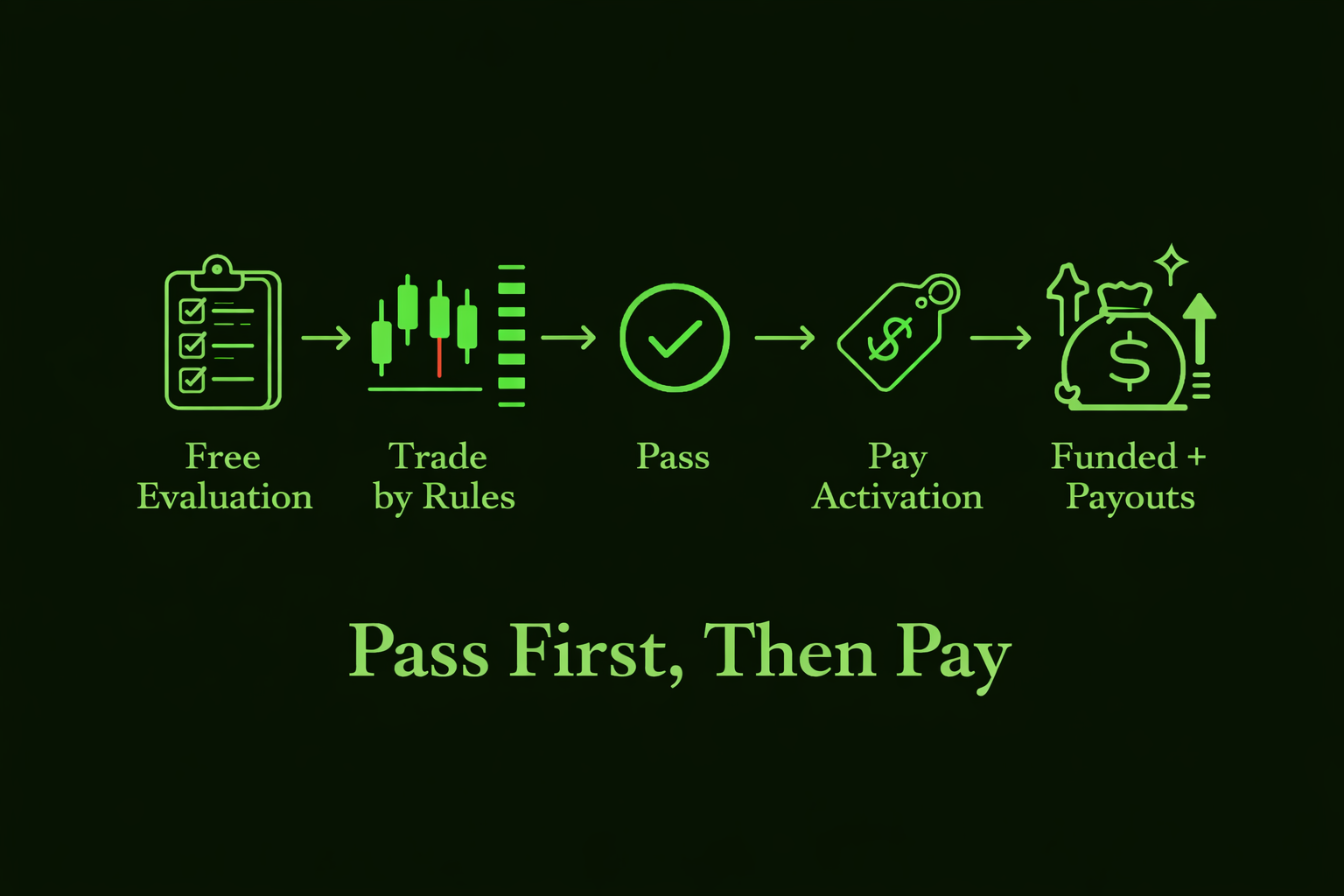
How a Pay Later Prop Firm Works
The structure follows the same logic as traditional prop firm evaluations, with payment moved to the final stage.
Start the Evaluation Without Paying Upfront
The trader begins trading without paying an evaluation fee. There is no sunk cost involved at the start. This removes the need to recover money before focusing on rule compliance.
Trade Under Firm Rules
The trader must follow predefined rules that usually include maximum drawdown, daily loss limits, profit targets, and restricted strategies. These rules are not relaxed. They are enforced in the same way as other prop firms.
Pass the Evaluation Through Consistency
To pass, the trader must reach the profit target while respecting all risk limits. Failure ends the evaluation, but no evaluation fee is lost. This reduces emotional pressure and forced decision-making.
Pay After Passing
Once the evaluation is passed, the trader pays to activate the funded account. Payment is linked to demonstrated behavior rather than expectation.
Trade a Funded Account
After activation, the trader trades firm capital and earns a profit split according to the firm’s payout rules.
How Upfront Fee Prop Firms Differ
Most prop firms require traders to pay before trading. This evaluation fee is usually non-refundable and must be paid again if the trader fails and wants another attempt.
This creates early financial pressure. Traders often increase risk or trade frequency to justify the fee. Even traders with solid strategies can fail due to behavior changes caused by sunk costs.
A pay-later prop firm removes this pressure during the most fragile phase of the process.
Pay Later Prop Firm vs Upfront Fee Prop Firm
The difference between these models affects trader behavior and outcomes.
A pay-later prop firm shifts the evaluation from a payment test to a skill test.
Why Traders Look for Pay Later Prop Firms
Search interest for pay pay-later prop firm often comes from traders who failed multiple evaluations despite having technical skill.
Overtrading Caused by Fee Pressure
When traders pay upfront, they often trade more frequently or increase position size to reach targets faster. This raises the chance of breaching drawdown limits.
Poor Decisions Near Drawdown Limits
Traders nearing loss limits may take unnecessary risk instead of reducing exposure. This behavior is tied to fear of losing the evaluation fee.
Emotional Responses to Losses
Losses feel heavier when money has already been paid. This leads to impulsive trades and rule violations.
A pay-later prop firm removes the sunk cost factor during the evaluation.
Risk Management in a Pay Later Prop Firm
Risk rules still apply. The model does not remove discipline. It changes incentives so discipline is easier to maintain.
Drawdown and Daily Loss Limits
Traders must respect maximum and daily loss thresholds. Breaches still end the evaluation.
Position Size Control
Lower risk per trade improves the chance of passing. Without upfront fees, traders are more willing to reduce size and wait for valid setups.
Trade Frequency
Traders are less likely to force trades when there is no fee to recover.
Is a Pay Later Prop Firm Good for Beginners
This model suits both beginners and experienced traders.
Beginners benefit from reduced early financial loss while learning prop firm rules. Experienced traders benefit from a fair evaluation that does not require repeated fees.
The evaluation filters by discipline, not payment tolerance.
Profit Splits and Funded Trading
After passing and paying, profit splits operate like other prop firms. Traders earn a percentage of profits and may qualify for larger accounts or higher splits after meeting consistency requirements.
The difference remains the entry point. Payment comes after proof.
Is a Pay Later Prop Firm Legit
Legitimacy depends on transparency, not on when payment occurs.
A legitimate pay later prop firm provides:
- Public trading rules
- Clear drawdown calculations
- Defined payout schedules
- Stable trading conditions
The model itself does not reduce credibility. It reduces early trader risk.
Who Should Use a Pay Later Prop Firm
This model fits traders who prefer structured progression and want to avoid repeated evaluation fees. It favors patience, rule compliance, and controlled risk.
Traders who rely on high-risk strategies to pass quickly may find this structure restrictive.
How PropFunding Uses the Pay Later Model
PropFunding applies a pay-later prop firm structure to align trader behavior with firm objectives. The evaluation focuses on drawdown control, rule compliance, and consistent execution. Payment follows proof, not assumption.
This approach supports traders who want a funding path based on results rather than repeated fees.
Is a Pay Later Prop Firm Worth It
For traders who want reduced early pressure and a fair evaluation structure, the answer is yes. The model places discipline before payment and skill before cost.
Final Thoughts on Pay Later Prop Firms
A pay-later prop firm changes the order of commitment. Traders prove their ability before paying. This single change affects behavior, risk management, and long-term outcomes.
For traders researching this topic, the focus is clear. They want a funding model that rewards discipline, limits unnecessary loss, and places proof before payment.
Frequently Asked Questions About Pay Later Prop Firms
What is a pay-later prop firm?
A pay-later prop firm allows traders to complete an evaluation before paying any fee. The trader trades under defined rules, respects drawdown limits, and reaches a profit target. Payment is required only after the evaluation is passed and the funded account is activated.
How does a pay later prop firm work?
The trader starts trading without paying an upfront evaluation fee. During the evaluation, the trader follows risk and drawdown rules. If the profit target is reached without violating rules, the evaluation is passed, and payment is made to access the funded account.
Is a pay later prop firm legit?
A pay-later prop firm can be legit if it provides clear public rules, transparent drawdown calculations, defined payout terms, and stable trading conditions. Legitimacy depends on rule clarity and enforcement, not on when payment is collected.
What is the difference between a pay later prop firm and an upfront-fee prop firm?
An upfront fee prop firm requires payment before trading begins. A pay-later prop firm requires payment only after the evaluation is passed. This difference affects early financial risk and how traders behave during the evaluation stage.
Is a pay later prop firm better for beginners?
A pay-later prop firm can be suitable for beginners because it limits early financial loss while learning how prop firm rules work. It is also suitable for experienced traders who want a proof-based evaluation without repeated evaluation fees.
Do pay later prop firms still have drawdown rules?
Yes. Pay later prop firms still enforce maximum drawdown and daily loss limits. The model changes when payment happens, not the importance of risk control and rule compliance.
Can you fail a pay-later prop firm evaluation?
Yes. If a trader violates drawdown rules or fails to meet the profit target, the evaluation ends. The difference is that no evaluation fee is lost when the trader fails.