Max Drawdown Prop Firm Meaning: What It Is and Why It Determines If You Pass
Understand the max drawdown prop firm meaning, how it works, how firms calculate it, and how to avoid violations in a pass-first-then-pay prop firm evaluation.
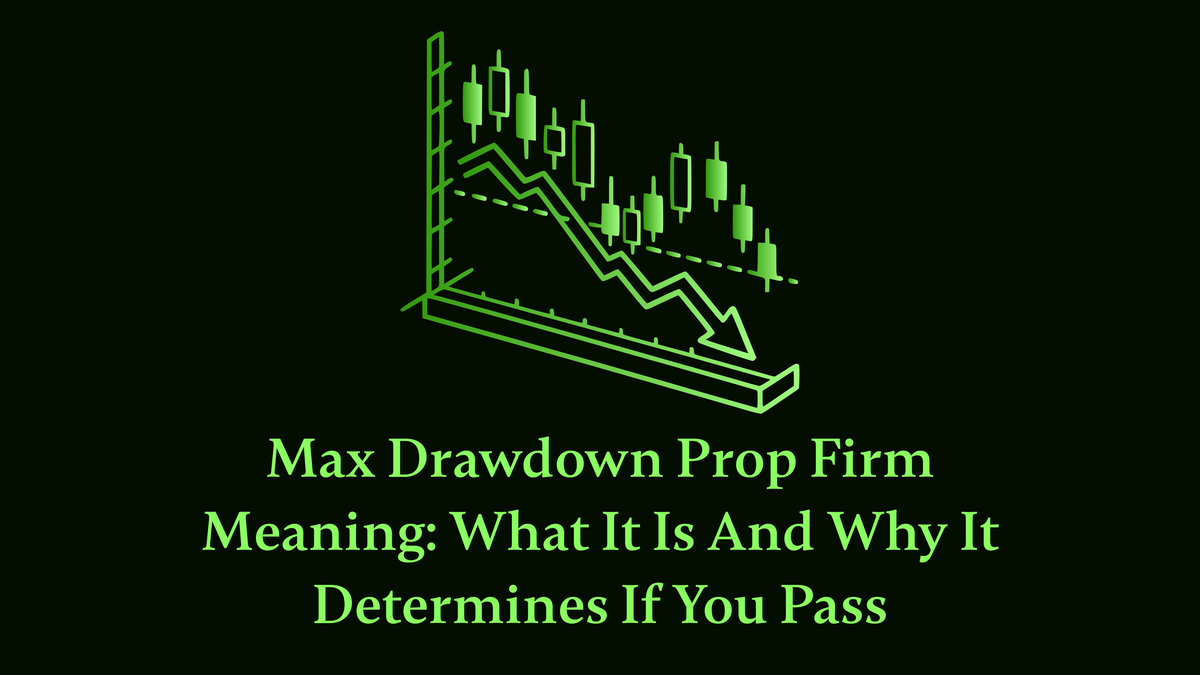
The max drawdown prop firm meaning refers to the total amount your account can decline before you fail an evaluation or lose a funded account. If you misunderstand the max drawdown prop firm's meaning, you risk failing even with a profitable strategy. Many traders lose their chance to qualify because they focus on daily profits and ignore overall drawdown limits.
In a structured evaluation, especially in a pass-first-then-pay model, maximum drawdown acts as the main long-term risk filter. If your equity falls below the allowed threshold, the account closes automatically.
This guide explains the max drawdown prop firm meaning in simple terms, shows how firms calculate it, and teaches you how to avoid violations.
What Is the Max Drawdown Prop Firm Meaning?
The max drawdown prop firm meaning describes the maximum total loss your account can reach before termination. It limits how far your equity can drop from a defined reference point.
Most firms set maximum drawdown as a percentage of the starting balance. For example, if you receive a $100,000 account with a 10% max drawdown, your account cannot fall below $90,000 at any time.
If equity touches $90,000, even briefly, you fail.
Unlike daily loss limits, maximum drawdown does not reset. It remains active throughout the entire evaluation.
How Prop Firms Calculate Max Drawdown
To fully understand the max drawdown prop firm meaning, you must know how firms calculate it. Firms usually use one of two structures: static drawdown or trailing drawdown.
Static Max Drawdown
With static drawdown, the firm calculates your limit from your starting balance. The threshold never moves.
If you begin with $100,000 and the max drawdown is $10,000, your minimum equity level stays at $90,000. Even if you grow the account to $110,000, the floor remains $90,000.
This model is easier to manage because the limit stays fixed.
Trailing Max Drawdown
Trailing drawdown works differently. The threshold moves up as your account grows.
Suppose your account rises from $100,000 to $105,000. In a trailing model, the drawdown floor may increase accordingly. Instead of remaining at $90,000, it might rise to $95,000.
This structure makes risk control more demanding. Many traders misunderstand the max drawdown prop firm's meaning in trailing models and accidentally violate the rule after normal pullbacks.
Max Drawdown Prop Firm Meaning vs Daily Loss Limit
The max drawdown prop firm's meaning differs from daily loss limits.
A daily loss limit restricts how much you can lose in one trading day. It resets at rollover. Maximum drawdown controls the total loss across the entire evaluation period.
You can respect daily limits every day and still fail by gradually hitting maximum drawdown.
Daily loss protects short-term risk. Maximum drawdown protects long-term capital.
You must manage both at the same time.
Why Max Drawdown Matters in a Pass-First-Then-Pay Model
In a pass-first-then-pay prop firm, traders do not pay up front. They only pay after passing the evaluation. Because of this structure, firms rely heavily on strict risk controls.
The max drawdown prop firm's meaning becomes even more important in this model. It ensures that only disciplined traders qualify. The firm removes upfront cost, but it enforces drawdown rules without flexibility.
If you breach the maximum drawdown, the system closes your account immediately. There are no exceptions.
Understanding and respecting maximum drawdown is the key to reaching the stage where you pass first and only pay afterward.
Common Reasons Traders Hit Maximum Drawdown
Most traders do not fail because of one large loss. They fail because of poor risk behavior over time.
Traders often increase position size after a losing streak. This decision accelerates the drawdown. Others ignore cumulative losses and focus only on daily limits. Some misunderstand trailing drawdown and do not realize their threshold has moved higher.
Each of these mistakes leads to violating the max drawdown prop firm meaning rule.
How to Avoid Violating Max Drawdown Rules
You avoid maximum drawdown violations by controlling risk before problems begin.
First, reduce risk per trade. Many professional traders risk less than 1% per position. Lower risk provides room for losing streaks without threatening the account.
Second, monitor total drawdown daily. Do not wait until you approach the threshold. Track your progress constantly.
Third, reduce position size after consecutive losses. When your account declines, smaller trades protect capital and slow further damage.
Finally, stop trading when emotions rise. Maximum drawdown violations often follow frustration or revenge trading.
Example of Proper Drawdown Management
Imagine you trade a $100,000 account with a $10,000 maximum drawdown and a $5,000 daily loss limit.
You decide to risk 0.75% per trade and stop trading for the week if the total drawdown reaches 6%. This rule creates a safety cushion below the maximum threshold.
By building a buffer, you avoid operating near the failure line. This discipline dramatically increases your probability of passing.
Final Thoughts on Max Drawdown Prop Firm Meaning
The max drawdown prop firm's meaning defines the ultimate risk boundary of your evaluation. It determines whether you continue trading or lose the account.
If you want to succeed in a pass-first-then-pay prop firm, you must prioritize capital protection over fast profits. Traders who survive long term respect drawdown limits. They scale risk carefully. They stay consistent.
Master maximum drawdown control, and you significantly increase your chances of qualifying and reaching funded status.